






AI & Emerging Tech
Tech and remote workers who don't use AI face triple the layoff risk, Gallup finds







One-quarter of workers who lost their jobs said they had been employed in fully remote roles, compared with 13% of currently employed workers who work entirely remotely.
Technology workers who fail to make artificial intelligence a regular part of their jobs are significantly more vulnerable to layoffs than their AI-savvy peers, according to new research from Gallup, highlighting how rapidly AI literacy is becoming a workplace differentiator.
The study, based on a February 2026 survey of more than 23,000 US workers, found that tech employees who use AI at least once a month face a predicted layoff risk of around 6%. For those who use AI less frequently, the figure jumps to 18%—three times higher.
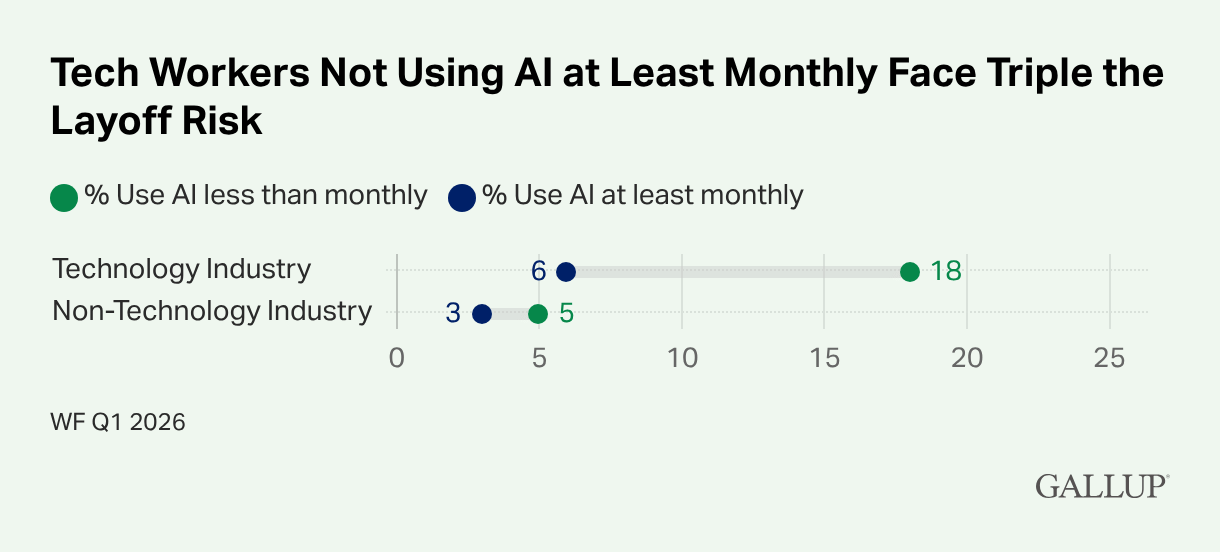
The relationship remained significant even after Gallup researchers accounted for factors such as age, education, industry and the length of time since workers were laid off. While AI use was associated with greater job security across the broader workforce, the effect was strongest within the technology sector.
The findings come as technology workers already appear to be bearing a disproportionate share of job losses. Gallup found that 13% of workers who reported being unemployed because of layoffs previously worked in the technology industry, despite tech workers accounting for only 6% of the currently employed workforce.
Remote workers were also overrepresented among the laid-off population. One-quarter of workers who lost their jobs said they had been employed in fully remote roles, compared with 13% of currently employed workers who work entirely remotely. By contrast, hybrid and on-site remote-capable employees were represented at similar levels among both laid-off and employed workers.
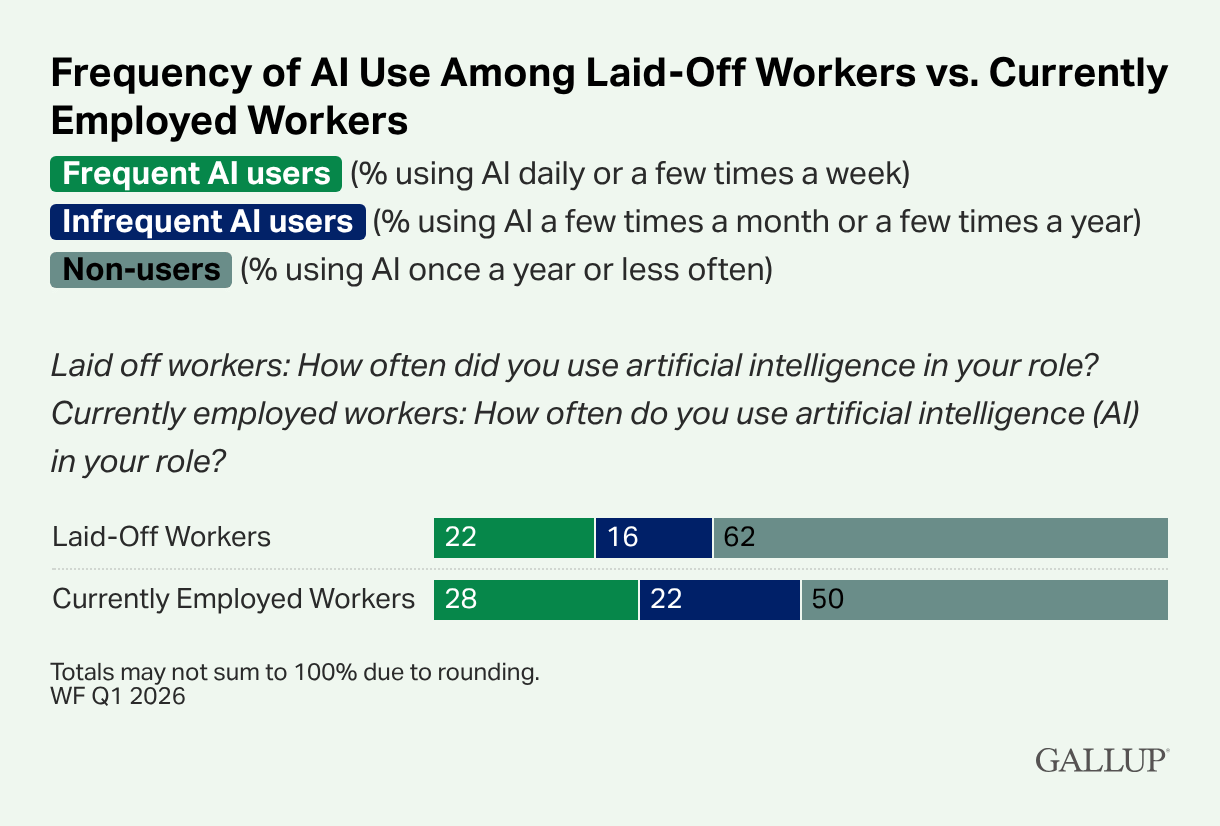
The data suggest that AI adoption is emerging as a fault line within organisations, influencing which employees may be better positioned to weather workforce reductions. Gallup's analysis found that workers who never used AI or used it only rarely were more likely to be among those who had lost their jobs, while frequent AI users were more likely to remain employed.
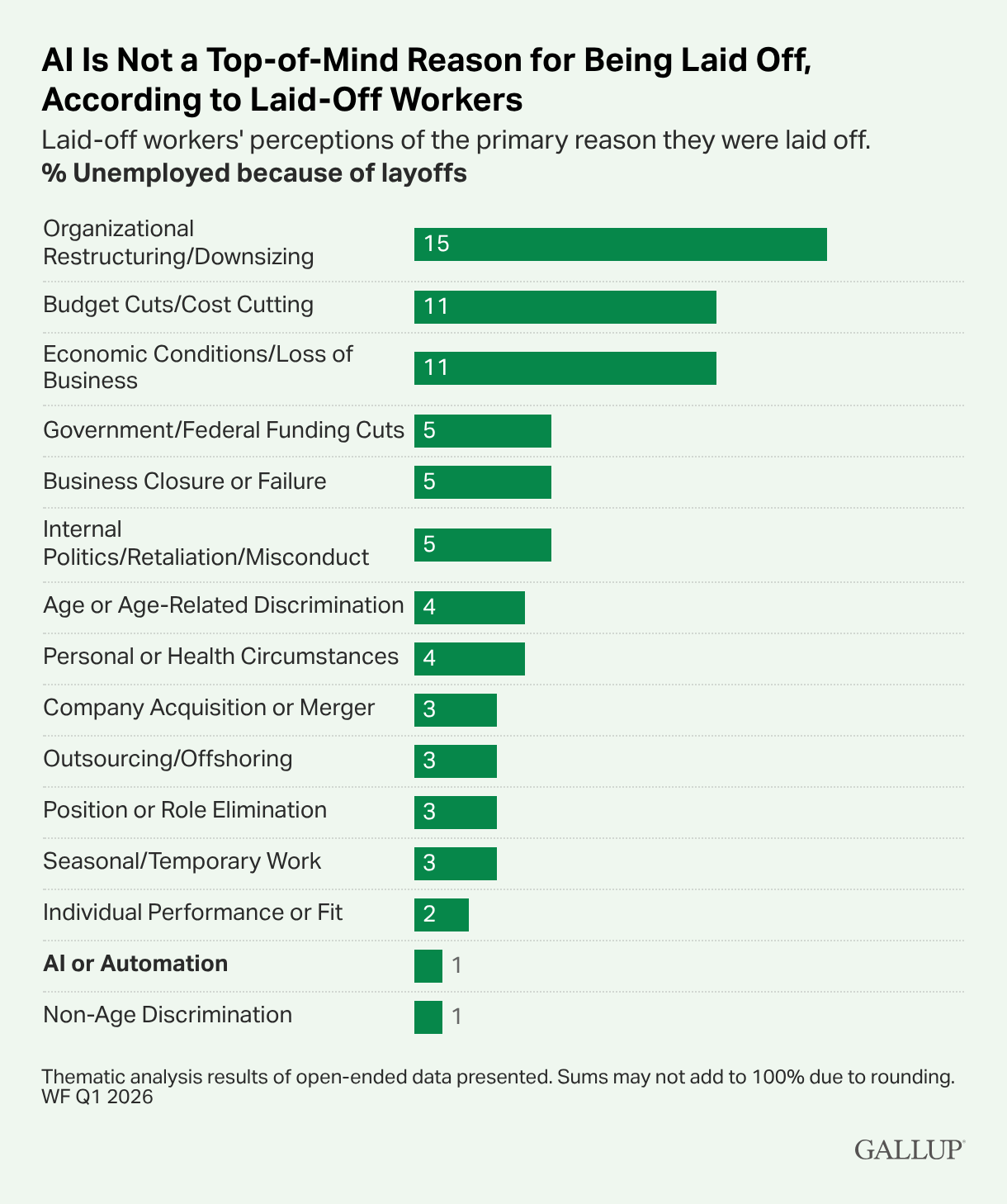
Despite growing concerns about automation-driven job losses, the survey found little evidence that workers themselves see AI as the direct cause of layoffs. Just 1% of laid-off respondents cited AI or automation as the primary reason for losing their jobs.
Instead, most workers pointed to organisational restructuring, cost-cutting initiatives and role eliminations. However, Gallup researchers cautioned that those explanations may mask AI's indirect influence, as companies increasingly redesign workflows, streamline operations and reassess staffing needs in response to new technologies.
“That surprised me the most,” said Jim Harter, chief scientist for Gallup’s workplace management and wellbeing practice. “They didn’t just blame AI.”
The finding stands in contrast to what employers are reporting publicly. According to outplacement firm Challenger, Gray & Christmas, AI accounted for roughly 40% of the reasons companies cited for job cuts announced last month, making it the most frequently cited factor behind workforce reductions.
Harter cautioned against interpreting the results as proof that AI usage should become a performance metric. Measuring employees based on how often they use AI tools or interact with chatbots could encourage superficial adoption rather than meaningful improvements in output.
“The real bottom line is: Are they more productive?” he said.
Gallup's analysis suggests the challenge for employers is not simply encouraging AI adoption but ensuring workers can use the technology effectively. The researchers noted that employee engagement with AI tools may serve as one indicator of workforce readiness as businesses increasingly integrate artificial intelligence into daily operations.
The study also challenges the popular narrative that AI is directly replacing large numbers of workers. Instead, it points to a more nuanced reality: employees who regularly use AI appear better positioned to adapt to changing workplace expectations, while those who do not may face greater vulnerability during periods of restructuring.
Author
Loading...