






AI & Emerging Tech
KPMG survey: Compliance leaders put AI skills and culture on HR agenda






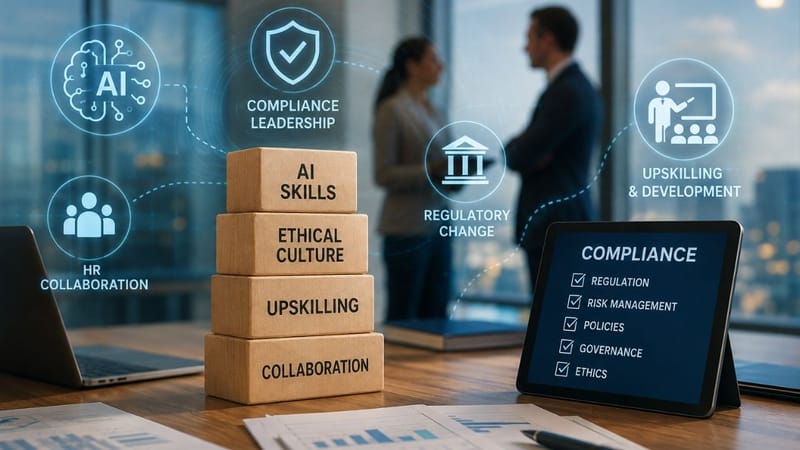
As regulatory and technology risks converge, CCOs are calling for stronger upskilling, ethical cultures and closer collaboration with HR.
Chief Compliance Officers are facing a more complex operating environment as artificial intelligence, cybersecurity threats, regulatory change and geopolitical uncertainty affect the risk landscape, according to KPMG’s 2026 Global Chief Ethics and Compliance Officer Survey.
The survey, which gathered responses from 725 CCOs across eight countries and six industry sectors, found that compliance leaders are increasingly moving beyond their traditional role as rule enforcers to become strategic partners for the business.
KPMG said the CCO is shifting from a reactive steward of rules and procedures to a proactive, data-driven leader who manages risk while also supporting business growth.
AI adoption exposes a skills gap
AI is emerging as an important part of compliance operations, but adoption remains cautious.
The survey found that 68% of CCOs describe their experience with AI as “mixed, leaning positive”, saying they have seen more benefits than challenges. Another 24% reported significant improvements in compliance efficiency and effectiveness.
However, AI is being used primarily for relatively routine and data-heavy activities. Half of respondents use AI for compliance risk assessment and management, while 44% use it for data visualisation and predictive analytics and another 44% for employee training and awareness.
More complex and sensitive activities remain less automated. Only 4% of respondents said their organisations use AI for hotlines and investigations, while 12% use it for anti-money laundering and 17% for drafting and reviewing legal documents and contracts.
Upskilling becomes a compliance priority
The findings point to a growing requirement for compliance professionals to develop technology and data skills alongside their traditional expertise.
Yet fewer than a quarter of respondents said they were very well prepared for upskilling compliance professionals, at 21%, while only 20% said they were very well prepared to enhance compliance culture.
KPMG recommends formal training programmes covering data literacy, how AI models work and the ability to interpret and challenge AI-generated insights.
The report also highlights a potential challenge for early-career talent. As AI takes over more entry-level tasks, junior employees may have fewer opportunities to develop the expertise needed to assess and challenge AI-generated outputs.
HR and compliance increasingly intersect
The changing role of compliance is also bringing the function closer to HR.
67% of CCOs said they were confident in assessing compliance synergies across functions including human resources, legal, investigations, internal audit and operations.
KPMG recommends integrating compliance into performance management, with compliance objectives and ethical behaviour incorporated into employee performance reviews and incentive structures.
The aim is to reinforce the idea that compliance is a shared responsibility rather than a function owned solely by the compliance team.
The report also stresses the importance of building an environment where employees feel safe to raise concerns without fear of retaliation, positioning ethical culture as a core part of risk management.
Regulatory change remains the biggest challenge
Despite the growing focus on technology and people, regulation remains the biggest concern for compliance leaders.
33% of CCOs identified new regulatory requirements as one of the top compliance challenges their organisations will face over the next two years. Data analytics and predictive modelling followed at 31%, while implementing technological tools was cited by 25% and upskilling compliance professionals by 24%.
For HR leaders, the findings point to a broader shift in organisational responsibility. As AI and regulatory complexity increase, compliance can no longer operate in isolation.
Skills development, employee behaviour, performance management, ethical culture and technology governance are increasingly becoming shared responsibilities across HR, compliance and the wider leadership team.
Author
Loading...