






Workforce Planning
Before we blame AI for every layoff, let's talk about the dot-com crash






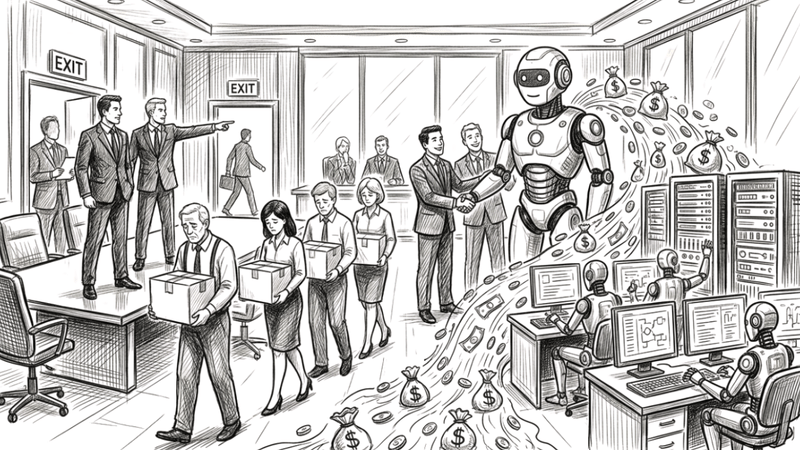
The dot-com era teaches us that workforce disruption rarely has a neat ending. Jobs evolve. Skills evolve. Entire industries evolve.
This article was first published in the latest edition of People Matters Perspectives.
After years of covering layoffs, one comparison keeps coming back to me. The dot-com crash and the AI boom may look similar on the surface, but they are telling us very different stories about the future of work.
Every morning, I open my inbox expecting to find another layoff announcement.
Sometimes it's a startup. Sometimes it's a global technology giant. Sometimes it's a company reporting healthy revenues, strong margins and ambitious growth plans.
And yet, there it is again. Another workforce reduction. Another restructuring. Another CEO explaining why fewer people are needed to build the future.
After writing about layoffs for years, I've noticed something interesting. Almost every conversation about today's job cuts eventually lands in the same place: AI.
Employees blame AI. Executives cite AI. Investors reward companies for becoming "AI-first".
The assumption seems obvious. Artificial intelligence arrived and layoffs followed. But the more I think about it, the less convinced I am that AI alone explains what we're seeing. To understand today's layoff wave, I keep finding myself looking backwards, not forwards. Specifically, to the early 2000s.
When the internet broke people's careers
I was still in school when the dot-com bubble burst, but anyone who followed technology at the time remembers the mood. The internet was supposed to change everything.
And to be fair, it did. Before the crash, investors were throwing money at almost anything with ".com" attached to its name. According to historical market data, the Nasdaq climbed dramatically through the late 1990s before losing nearly 78% of its value between 2000 and 2002.
Companies disappeared overnight. Jobs vanished with them. People lost savings, careers and, in some cases, entire professional identities.
Looking back, what strikes me most is how straightforward the story was. Businesses failed, cut jobs. The relationship was painful but logical. Nobody looked at a bankrupt startup and wondered why it was laying people off. The company simply didn't have any money left.
Today's layoffs feel different for a reason
This is where I think many comparisons between the dot-com era and the AI era start to fall apart. The companies making layoff headlines today are not necessarily failing. Many are thriving. Some are among the most profitable businesses in the world.
Over the past year, I've reported on organisations announcing workforce reductions while simultaneously increasing investments in artificial intelligence, data centres and automation.
That's a very different story from the one we saw in 2000. Back then, companies cut jobs because they were running out of money. Today, many companies are cutting jobs because they believe technology can help them operate with fewer people. One is a crisis of failure. The other is a pursuit of efficiency. And I suspect employees can sense the difference. Losing your job because a company is collapsing is devastating. Losing your job because the company believes it can do more with less is something else entirely.
It raises uncomfortable questions about value, productivity and what employers really mean when they say people are their greatest asset.
We may be blaming AI for a much bigger shift
Another pattern I've noticed in my reporting is that AI often becomes the headline because it offers a simple explanation.
Reality is messier. Many companies are still correcting pandemic-era overhiring.
Others are responding to investor pressure. Some are redesigning organisations around leaner structures. Several are removing layers of middle management. AI is part of the story. I don't think it is the whole story.
In some ways, AI has become a convenient label for a much broader workforce reset that was already underway.
The lesson I keep coming back to
The biggest lesson from the dot-com era isn't that technology destroys jobs. It's that technology changes jobs faster than people expect. The internet eliminated roles. Then it created entirely new industries. Social media managers didn't exist. Cloud architects didn't exist. App developers didn't exist.
Yet millions of people eventually built careers around technologies that once looked threatening.
I suspect AI will follow a similar path. Not because history repeats itself perfectly. It never does.
But because every major technological shift creates the same period of uncertainty where old jobs disappear before new ones become visible.
The question we're asking is wrong
Whenever another layoff story lands on my desk, I see the same question in comment sections and LinkedIn posts. "When will the layoffs end?"
After spending years covering this space, I don't think that's the question we should be asking. The dot-com era teaches us that workforce disruption rarely has a neat ending. Jobs evolve. Skills evolve. Entire industries evolve.
The better question is what kind of workforce emerges once the dust settles.
Because if history is any guide, the future won't belong to the people who accurately predicted every change.
It will belong to the people who adapted while everyone else was trying to figure out what came next.
Author
Loading...