







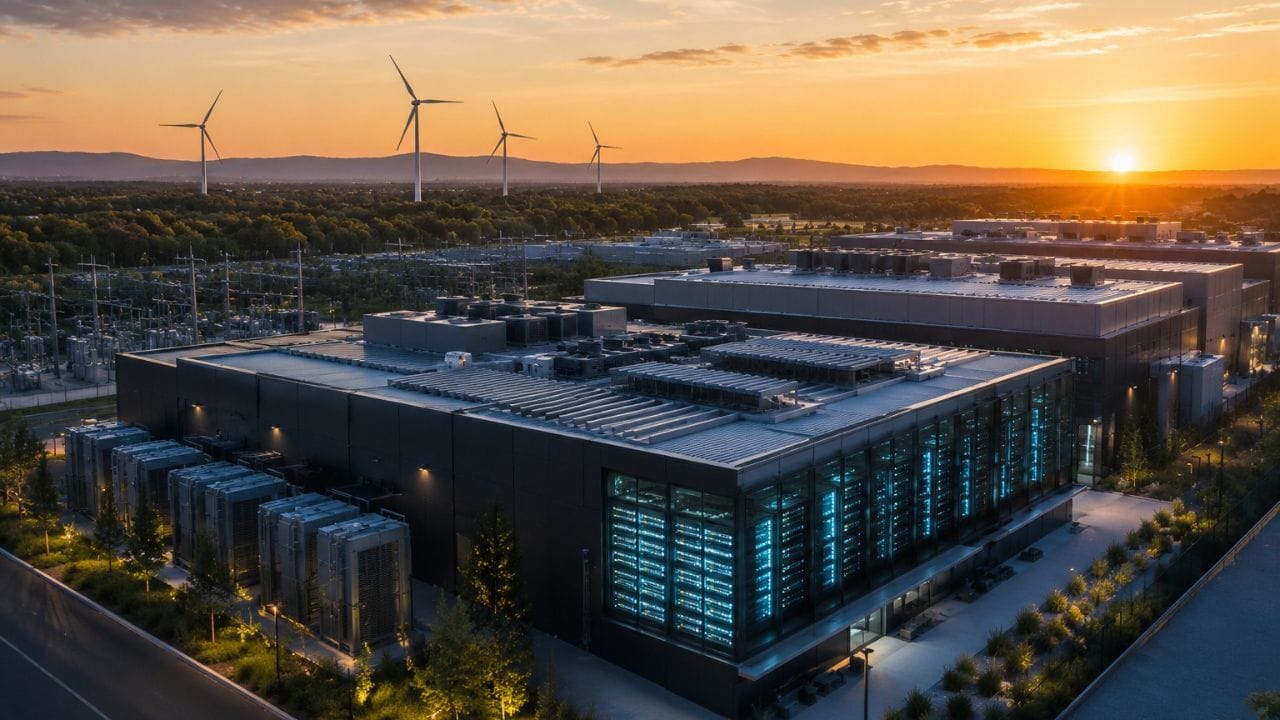
Australia’s race to expand its AI infrastructure is moving beyond technology and investment, with potential implications for jobs, skills and workforce planning.
Internal NSW government emails have revealed that US AI company Anthropic had expressed interest in developing up to 5 gigawatts of AI data centre capacity in New South Wales.
Australia currently has around 1.6GW of total data centre capacity, meaning Anthropic’s proposed NSW requirement would be more than three times the country’s existing infrastructure.
For HR professionals and business leaders, the development highlights a wider shift underway as AI investment creates demand for talent across data centres, cloud computing, cybersecurity, engineering, energy, construction and digital infrastructure.
AI data centre boom creates new workforce demands
AI models require significant computing power and electricity, driving technology companies to secure data centre capacity and reliable energy supplies.
In an email dated March 18, Dena Jacobs, executive director of Infrastructure NSW, told senior public servants that Anthropic's CEO was planning to visit Sydney to discuss locating up to 5GW of AI training capacity in NSW.
"The context is that the CEO of Anthropic is visiting Sydney and would like to speak to the NSW government about the opportunities to locate up to 5GW of AI training capacity in NSW. i.e. there's an opportunity to locate this outside Sydney," she wrote.
The expansion comes amid growing concerns over the electricity and water demands of data centres, as well as heat, noise and their impact on local communities.
With more than $150 billion lined up for data centre development and investment in Australia, the growth could also increase demand for technical talent and put greater pressure on businesses to build the workforce capabilities needed to support the sector.
AI investment could reshape Australia's talent market
The expansion of data centre infrastructure could have significant implications for the Australian labour market.
Large-scale data centres require workers across engineering, construction, energy management, facilities, cybersecurity, cloud computing and operations. The projects can also create demand for project managers, skilled tradespeople and specialists capable of managing complex technology infrastructure.
For HR leaders, this could increase competition for already scarce technical skills.
The challenge is not limited to recruiting. Businesses will also need to consider how existing employees can be reskilled as AI changes job requirements and creates new roles.
The growth of AI infrastructure could therefore make workforce planning, skills development, talent acquisition and reskilling increasingly important components of business strategy.
Rather than treating AI as an IT investment alone, organisations may need to consider its impact across their entire workforce.
Australia emerges as an AI infrastructure hub
Anthropic's interest comes as Australia seeks to attract investment from global technology companies while expanding its digital infrastructure.
Australia's land availability, renewable energy resources and political stability have helped make the country an attractive destination for data centre development.
Olivia Shen, director of the Strategic Technologies Program at the United States Studies Centre at the University of Sydney, said Australia offered several advantages for US technology companies.
"One is just that we have lots of land. Another is that we have huge amounts of renewable capacity, particularly solar energy, and the third is that we are a stable democracy," she said.
Australia is also a significant market for AI adoption. Anthropic said in June that Australia ranked first globally for use of its Claude platform when adjusted for the working-age population.
The combination of strong AI adoption and growing infrastructure investment could further increase demand for AI-related skills across the Australian economy.
Governments compete for AI investment
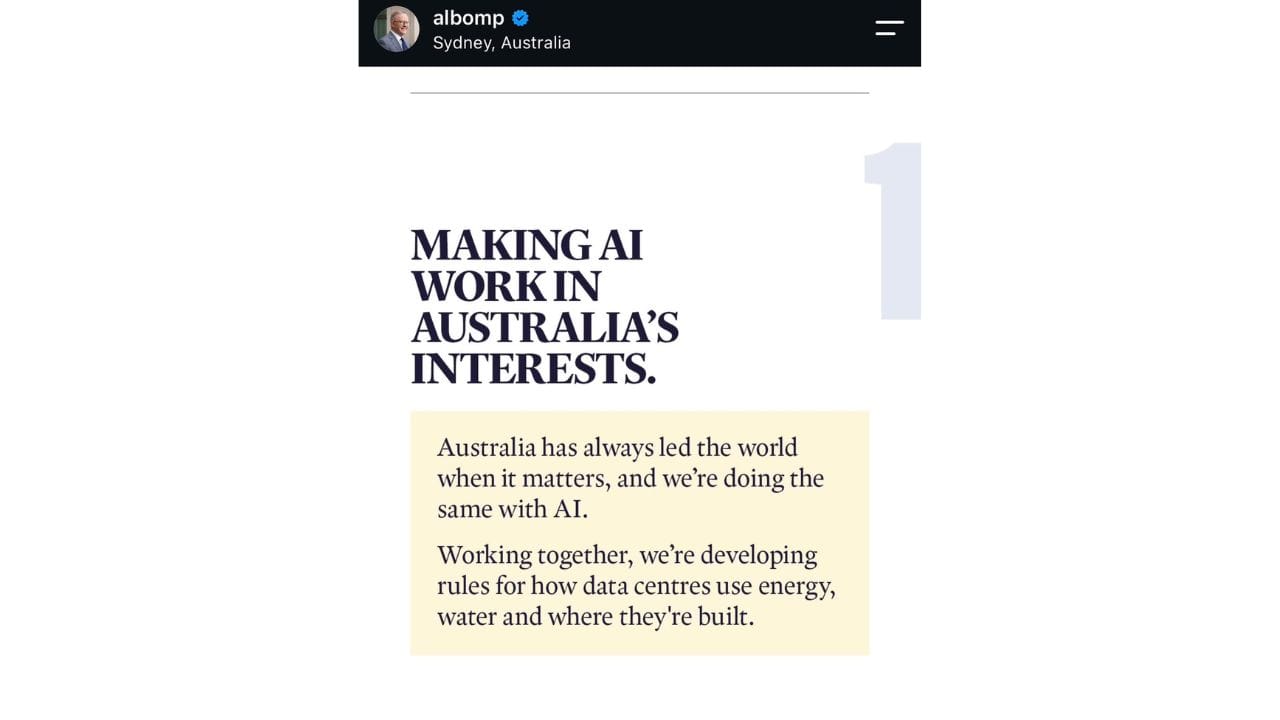
The Prime Minister has also highlighted the government's approach to AI infrastructure in a recent social media post, saying Australia is developing rules around how data centres use resources and where they are built.
NSW Innovation, Science and Technology Minister Anoulack Chanthivong said the state remained open to technology investment.
"The Minns Labor government continues to welcome investment from leading technology companies," he said.
The policy discussions come as governments attempt to balance the economic benefits of AI infrastructure investment with growing concerns about its environmental and community impact.
State and federal governments are also developing policies to manage the expansion.
NSW recently announced new energy, water, environmental and community requirements for data centres. Under the framework, qualifying developments must fund additional water and energy supply and ensure there is no net cost to consumers and communities.
In return, developers will receive a commitment that development applications will be assessed within 75 days.
The federal government is also working with states on national standards for large-scale data centres. The proposed framework is expected to cover issues including energy use, water consumption, copyright protections, workers' rights and computing capacity for Australian businesses and researchers.