







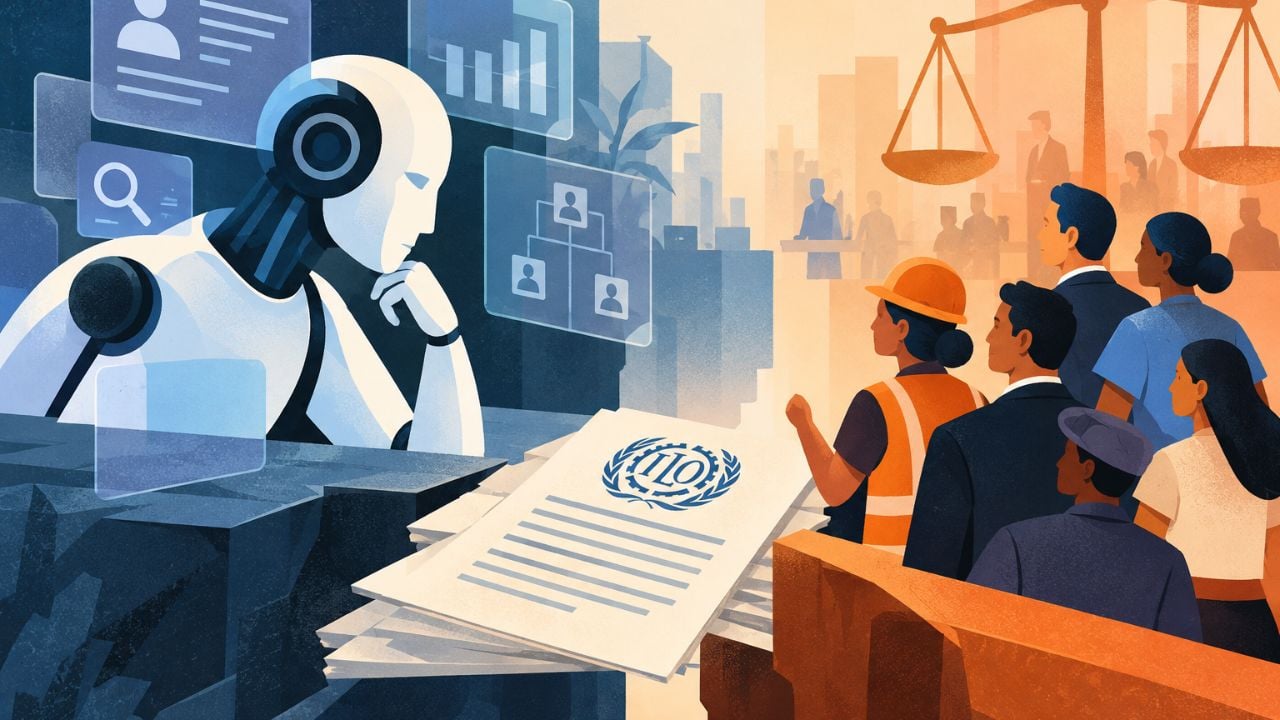
Most artificial intelligence (AI) ethics guidelines that discuss the workplace fail to mention international labour standards, according to a new working paper from the International Labour Organization (ILO).
Published in October 2026, the paper reviews 245 AI ethics guidelines. It finds that more than 60% discuss AI and work, but fewer than 20% mention the ILO or its standards.
The authors, Jordi Agustí-Panareda and Daniel Samaan, say this leaves an important gap in how AI is governed in the workplace.
AI guidelines miss key labour standards
The review, which is due to be published in the European Management Journal, analysed AI ethics guidelines from different organisations using natural language processing and large language models.
Many guidelines discuss concerns about jobs, working conditions and workplace relationships. However, few treat labour markets as a separate area of AI governance.
"The gap is particularly striking given that the governance of labour has long been shaped by international labour law with its well-developed normative system under the auspices of the ILO," the authors wrote.
They added, "Much of the ethics discourse proceeds in isolation from the century-long normative architecture developed by the ILO."
Collective bargaining remains a major concern
The paper compares five AI ethics principles, justice, beneficence, non-maleficence, autonomy and explicability, with the principles behind the ILO's labour standards.
The authors found common ground on fairness, preventing harm and promoting well-being.
However, they said AI ethics guidelines tend to focus on individuals, while labour standards also protect workers' collective rights.
One key gap is collective bargaining, which allows workers to negotiate employment terms and conditions.
"For the right of collective bargaining, however, we do not see a clear ethical equivalent in existing AI ethics frameworks," the authors wrote.
The paper also highlights the strength of the ILO's framework, which is based on international agreements and supported by systems that monitor how standards are applied.
These commitments, the authors argue, "provide a level of clarity, legitimacy, and durability that most contemporary AI ethics frameworks typically do not yet possess."
What this means for HR leaders
The findings raise questions for employers using AI to hire staff, assess performance or make decisions about dismissals.
The authors say responsible AI policies should consider workers' rights, including protection against discrimination, freedom of association and collective bargaining.
They also stress the need for transparency when AI influences employment decisions.
Employers should be able to explain the data and reasoning behind these decisions so that their legal validity can be assessed.
For HR leaders, this means ensuring that AI policies go beyond fairness and efficiency to account for existing labour laws and workers' rights.
ILO calls for closer links between AI ethics and labour rights
The paper calls for AI ethics guidelines to draw more closely on international labour standards and the ILO's framework, which brings together governments, employers and workers.
They concluded, "AI ethics in the world of work should be developed not in isolation, but in closer dialogue with the ILO's normative framework, its tripartite governance, and its supervisory institutions."
The authors argue that this would help organisations develop workplace AI policies that recognise both individual rights and workers' collective interests.