
Conversations around fairness, inclusion, and workplace equity often remain trapped in the language of policy documents, annual reports, and corporate intent statements. But beneath the surface of diversity metrics lies a far more difficult question: what does it actually take to create workplaces where opportunity is genuinely accessible to everyone?
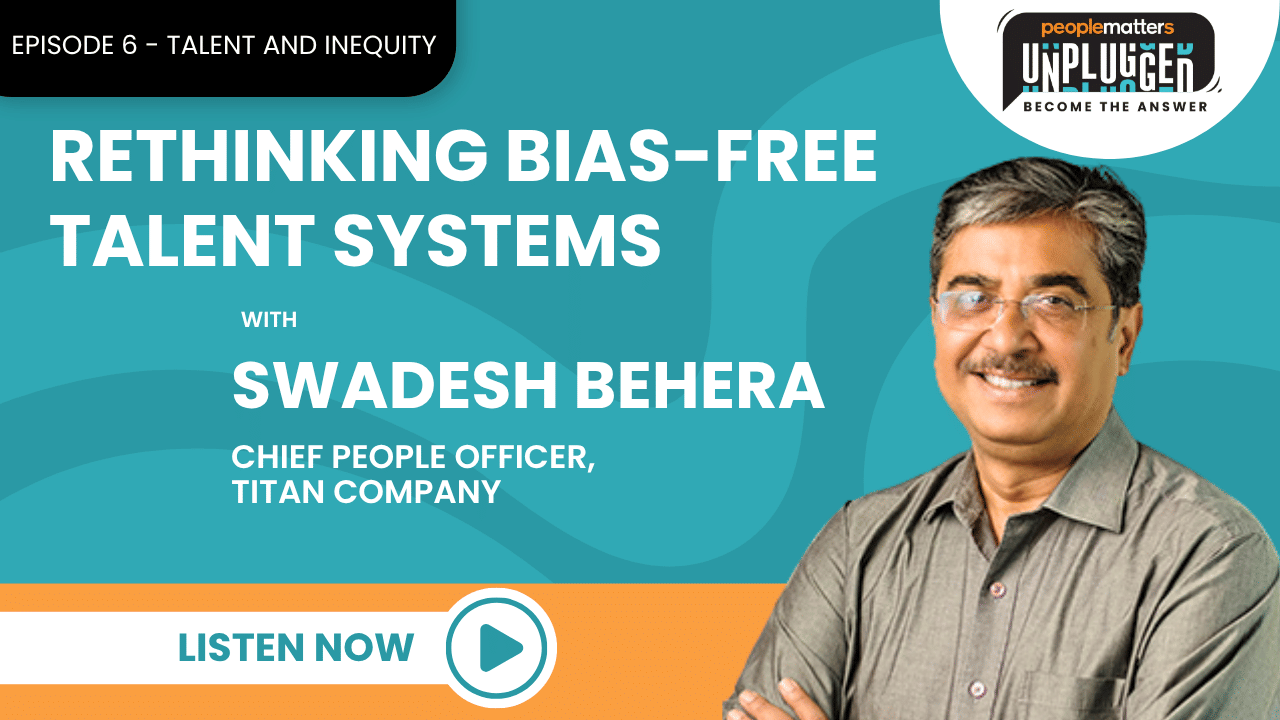
That question formed the heart of a recent People Matters Unplugged conversation where Cheshta Dora, Head of Content, Research and Community at People Matters, is joined by Swadesh Behera, Chief People Officer at Titan Company, about how organisations can move beyond performative DEI and build fairer talent systems.
As the people leader, Swadesh shares insights on tackling bias through leadership, governance, technology, and listening-led HR practices. The episode also explores AI-powered talent marketplaces, inclusive career mobility, and maternity support frameworks shaping equitable workplaces today.
Equity cannot depend on goodwill alone
One of the strongest themes emerging from the conversation was Behera’s belief that fairness must be intentionally designed into organisational systems.
“Equity needs intentional design and not just goodwill,” he said during the discussion.
According to Behera, Titan’s progress has come less from symbolic initiatives and more from embedding fairness into policies, promotion frameworks, governance systems, and leadership accountability structures.
At the same time, he acknowledged that workplace inequities are often rooted in wider social conditioning.
Employees enter organisations carrying biases shaped by families, schools, social environments, and cultural stereotypes. Those biases, he explained, subtly influence hiring decisions, promotions, responsibility allocation, and perceptions of competence.
Tackling unconscious bias through open conversations
One practical intervention Titan has introduced is a series of “I Belong” sessions designed to openly discuss unconscious bias across teams.
These conversations address subtle but common workplace stereotypes, assumptions based on gender, region, language, disability, or background that may unconsciously influence managerial decisions.
Behera explained that the objective is not to pretend bias does not exist, but to make employees aware of how those biases affect workplace behavior.
For example, assumptions around whether women can manage larger teams, whether employees from certain regions “fit” organisational culture better, or whether differently abled employees can perform at the same level as others are all discussed openly during these sessions.
The idea, according to Behera, is to ensure that managers make decisions based on competence rather than preconceived notions.
Governance structures to reduce inequity
The conversation also highlighted how Titan is building governance mechanisms around fairness.
One such mechanism is the company’s ethics line, where employees can report experiences related to discrimination, bias, or unfair treatment. Behera noted that these cases are taken seriously and formally investigated.
Another major initiative is Titan’s annual “Tell Me” listening exercise, where senior leaders, including the managing director and HR leadership, spend close to 90 to 100 hours meeting employees across functions and workforce segments.
These conversations have become a key source of organisational feedback and policy design.
According to Behera, several employee concerns repeatedly surfaced during these sessions, particularly around career visibility, internal mobility, and access to growth opportunities.
Using AI to democratize career growth
One of Titan’s most practical interventions has been the introduction of an AI-powered internal talent marketplace.
The platform allows employees to map career aspirations while receiving recommendations for projects, assignments, and cross-functional opportunities aligned with their growth goals.
Behera explained that the system helps employees build exposure beyond their current functions.
For instance, a salesperson interested in merchandising could receive recommendations for merchandising-related projects before formally applying for a role in that area later.
The platform also aims to reduce dependency on managerial visibility or internal networks for career progression.
“Technology has democratized many of our initiatives and can take opportunities to the last mile,” Behera said.
Titan also redesigned its internal hiring communication process after employees repeatedly expressed frustration about not hearing back after applying for roles internally.
Managers are now expected to explain rejection decisions to unsuccessful candidates before final offers are rolled out.
Extending inclusion beyond corporate employees
A major part of the discussion focused on Titan’s artisan ecosystem and outsourced workforce, groups often left out of mainstream workplace inclusion conversations.
In the jewelry business, the company has created karigar parks designed to provide artisans with safer and more structured working environments.
Similarly, Titan has established dedicated weaver salas across sari clusters in different parts of India to improve infrastructure and working conditions for weaving communities.
Behera also highlighted Titan’s engagement with outsourced employee groups such as housekeeping staff and security personnel.
After conducting listening sessions with these workforce segments, the company introduced “floor wages” positioned slightly above statutory minimum wages.
The initiative emerged directly from employee conversations around financial pressures and living conditions.
Supporting employees with caregiving responsibilities
Another significant part of the discussion centered around caregiving and motherhood.
Behera revealed that Titan analysed experiences of hundreds of women employees returning from maternity leave and found that many struggled with anxiety around both career continuity and workload management.
To address this, the company introduced a detailed maternity cover framework outlining step-by-step processes for both employees and managers.
The policy includes multiple options for temporary work redistribution, including:
Job-sharing arrangements
Internal bridge projects
Temporary project-based support
Coverage through Titan’s “Sequel” program for women restarting careers after long breaks
The company also introduced structured counseling conversations between employees, managers, and HR business partners before and after maternity leave to help women transition back into work more smoothly.
Beyond maternity support, Titan introduced additional flexibility for employees raising children with special needs.
According to Behera, employees in this category are allowed shorter work hours along with additional financial support.
Inclusive leadership as a managerial expectation
The discussion also explored how Titan is attempting to cascade inclusion practices across management layers.
Behera emphasized that managers sit at the center of employee experience because employees often experience organisational culture through their direct leaders rather than through corporate messaging.
To strengthen managerial accountability, Titan introduced a leadership framework called “Crest,” built around nine managerial commitments expected from leaders across all levels.
These commitments include:
Building inclusive work environments
Understanding employee aspirations
Supporting career development
Rewarding employees fairly
Encouraging growth conversations
Behera noted that inclusive leadership is treated as a core requirement rather than an optional capability.
Measuring fairness through mobility and promotions
Interestingly, Behera argued that representation numbers alone do not fully reveal whether an organisation is equitable.
Instead, he pointed to promotion and mobility patterns across employee groups as more meaningful indicators.
According to him, deeper analysis of promotion outcomes often reveals whether biases continue to influence opportunities behind the scenes.
“If you deeply examine promotion conversations and mobility patterns, you will know whether opportunities are truly being distributed equally,” he said.
Listening before building policies
Toward the end of the conversation, Behera stressed that organisations should avoid copying DEI practices simply because they are trending elsewhere.
Instead, he argued that solutions should emerge directly from employee experiences and workforce realities.
“There is no one universal policy,” he said. “The more you listen to different employee cohorts, the better your solutions become.”
The conversation ultimately reflected a larger shift happening within HR leadership today, where organisations are increasingly being pushed to move beyond symbolic inclusion conversations and focus instead on operational fairness, employee experience, and systemic access to opportunity.