







Not just companies, but entire nations are now locked in a race to develop the most powerful generative AI tools. Every week brings a new contender—one day, it’s the launch of the cost-effective Deepseek, the next, Elon Musk unveils his latest AI breakthrough. As governments and enterprises invest billions into AI research and development, the competition is fiercer than ever, pushing innovation at an unprecedented pace.
For businesses, this rapid evolution presents both opportunities and dilemmas. With so many AI tools emerging, selecting the right one for your organization is no easy task. Each tool offers unique capabilities, from text generation and reasoning to multimodal capabilities and deep learning applications. But with so much at stake—productivity, cost savings, and even ethical considerations—how do you decide which AI best fits your needs?
While we can’t make that decision for you, we can certainly help you navigate this complex landscape. Let’s break down the leading generative AI tools, from ChatGPT to Deepseek, evaluating their strengths, weaknesses, and ideal use cases.
1. OpenAI’s ChatGPT
ChatGPT, developed by OpenAI, is one of the most widely recognized generative AI models. With its foundation in large language models (LLMs), ChatGPT provides high-quality text generation, problem-solving, and conversational capabilities. It has been integrated into multiple industries, including customer service, education, and software development.
Key Features:
- Natural Language Understanding: Capable of understanding and generating human-like text with contextual awareness.
- Multi-Turn Conversations: Retains context across multiple exchanges, making it highly effective for chatbots and virtual assistants.
- Extensive Knowledge Base: Trained on a diverse dataset, offering insights across various domains.
- Code Assistance: Helps developers with debugging, writing code, and improving software efficiency.
- Enterprise Integration: Used in Microsoft Copilot and other AI-driven enterprise tools.
2. Google’s Gemini AI
Google’s Gemini AI, developed by DeepMind, is another powerful generative AI tool competing with OpenAI’s ChatGPT. It is designed to integrate seamlessly with Google’s ecosystem, providing AI-powered assistance in search, productivity tools, and research applications.
Key Features:
- Multimodal Capabilities: Processes and generates text, images, and other forms of data simultaneously.
- Advanced Reasoning: Offers enhanced problem-solving skills, making it useful for research and business intelligence.
- Integration with Google Services: Works across Google Search, Google Docs, Gmail, and Google Meet.
- Custom AI Models: Tailored solutions for specific enterprise needs.
- Data-Driven Insights: Provides actionable recommendations for businesses and researchers.
3. Microsoft Copilot
Microsoft’s Copilot is an AI assistant embedded into its suite of business applications, such as Microsoft 365, Azure, and Dynamics 365. By leveraging generative AI, Copilot enhances productivity, automates workflows, and aids in content creation.
Key Features:
- AI-Assisted Writing: Generates professional emails, documents, and presentations.
- Real-Time Collaboration: Enhances productivity tools like Word, Excel, and Teams.
- Predictive Analytics: Helps businesses make data-driven decisions.
- Accessibility Features: Provides real-time captions and AI-driven assistance for neurodiverse employees.
- Enterprise Security: Maintains compliance with Microsoft’s security and privacy standards.
4. Elon Musk’s xAI Grok-3
Grok-3 is the latest AI model from xAI, backed by Elon Musk. Designed with advanced reasoning capabilities, Grok-3 aims to compete directly with OpenAI and Google by providing in-depth problem-solving solutions.
Key Features:
- High Compute Power: Offers over ten times the computing capability of previous models.
- Step-by-Step Reasoning: Features a ‘Think’ mode for breaking down complex questions.
- Big Brain Mode: Handles demanding AI tasks with precision.
- Real-Time Integration with X (formerly Twitter): Enhances user engagement with AI-generated content.
- Privacy-Focused Approach: Aims to provide more transparent AI interactions.
5. OpenAI’s o1 Model
The o1 model represents OpenAI’s next-generation AI research focused on deep reasoning. Unlike previous models, o1 spends more time deliberating before responding, making it highly effective for complex problem-solving.
Key Features:
- Deliberative Thinking: Spends extra processing time analyzing difficult queries.
- Enhanced Problem-Solving: Excels in coding, scientific research, and mathematics.
- AI Ethics and Transparency: Designed to reduce biases and improve AI safety.
- Adaptive Learning: Continuously refines its knowledge and reasoning abilities.
- Improved Creativity: Offers higher-quality content generation for professional applications.
6. DeepSeek AI
DeepSeek is an emerging, cost-effective AI model making waves in the generative AI space. Offering an open-source alternative to the pricier models from OpenAI, Google, and Microsoft, it enhances accessibility for developers and businesses. However, due to security concerns, it has been banned in Australia.
Key Features:
- Affordable AI Access: Reduces the cost barrier for businesses and researchers.
- Partially Open-Source Model: Encourages innovation in AI development.
- Competitive Performance: Challenges mainstream AI models with efficient performance.
- Customization Options: Allows businesses to fine-tune AI capabilities.
- Scalability: Suitable for enterprises looking to integrate AI into their operations without high costs.
Comparing the Top Generative AI Tools
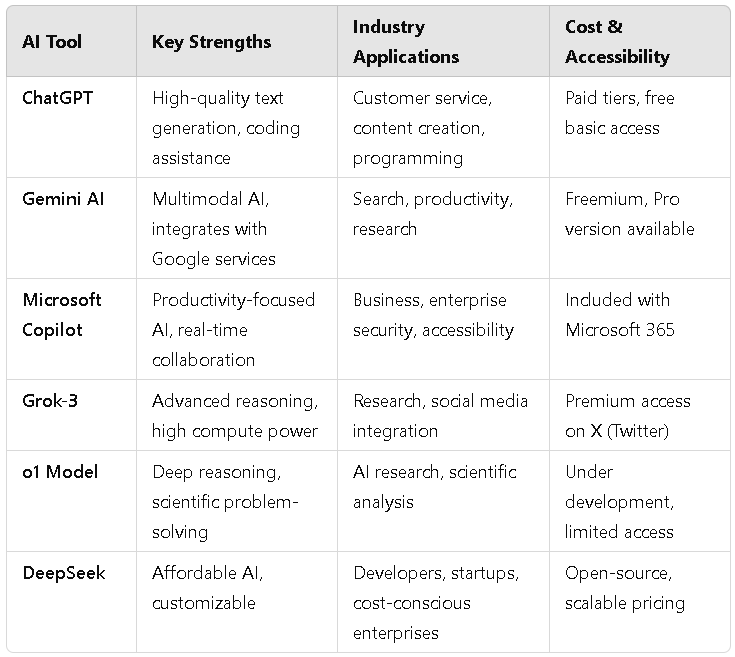
To better understand how these AI tools stack up against each other, here’s a comparative overview:
The Future of Generative AI
Generative AI is rapidly reshaping industries, with companies continuously pushing the boundaries of what these tools can achieve. Whether it’s OpenAI’s deep reasoning models, Google’s multimodal AI, Microsoft’s business integration, or DeepSeek’s cost-effective solutions, each tool brings unique advantages to the table.
As AI technology advances, we can expect improvements in reasoning, creativity, and ethical AI practices. The focus will likely shift toward making AI more transparent, customizable, and accessible while ensuring robust safeguards against misinformation and bias.
With the increasing competition in the AI space, businesses and individuals must carefully evaluate their needs and choose the right AI tool that aligns with their goals. Whether it’s enhancing productivity, automating tasks, or conducting advanced research, the right generative AI tool can unlock new possibilities in innovation and efficiency.